REPUBLIC OF CAMEROONARCHDIOCESE OF YAOUNDCOLLÈGE JEAN TABI D'ÉTOUDI
GENERAL REPORT OF THE SEMINARTEACHER CAPACITY-BUILDING SEMINAR ON 17, 18, 19 AUGUST 2022THEME :
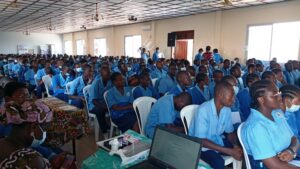
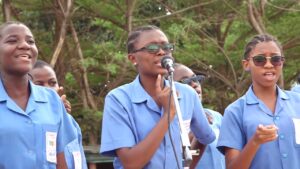
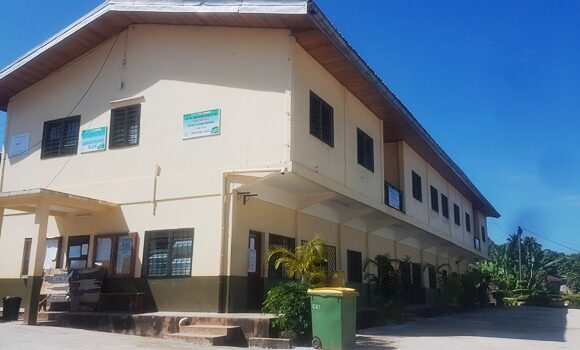
"TAKING ACQUISITE OF STAFF INTO ACCOUNT TO IMPROVE EFFECTIVENESS" TARGET OBJECTIVES: - To learn how to perpetuate the values of a social group - To consolidate what has been learnt about classroom practices and assessment In a bid to keep up with the best schools in the area, Collège Jean Tabi organises a capacity-building seminar not only for its staff but also for teachers from other Catholic schools. This year we had the privilege of sharing this experience with colleges such as Notre Dame de Victoire de Mvog-Ada, Joseph Stintzi d'Obala. On Wednesday 17August 2022, it was 8.20 a.m. when the moderator and trainer Monsieur NOAH Nestor took the floor to outline the various phases of the 2022 training session, which generally consisted of a phase reserved for presentations on the transmission and perpetuation of values and a more technical phase on classroom practices and assessment. To ensure the smooth running of this time of formation at the Collège Jean TABI, the activities began with a prayer led by sister BERONICE who entrusted to the Lord all the seminarians, including the smooth running of activities throughout this time of learning, and thanked him for having allowed us to meet again. The rest of the programme was marked by speeches from the SSCM regional superior I named Sister Anastasie BEKONO who, after wishing all the seminarians a fruitful stay, made it his duty to officially present to all the staff the new principal sister in the person of Sr. Hortense Victorine NYAMOUTH. Subsequently, Sister Anastasie is going to congratulate all the co-operators for their hard work over the past year with good results: 100% at BEPC, 100% at PROBATOIRE, 99.51% at BACALAUREATE with several commendations. In her first public appearance, the Reverend Senior Sister Victorine Hortense NYAMOUTH extended a warm welcome to all her co-operators and to all the establishments represented, without forgetting the resource persons. To underline the importance of this time, she made her own the maxim that says: "If you stop learning, you must stop teaching". Hence the need to take advantage of this time to recharge our batteries and build up the knowledge needed to provide quality supervision for learners. With the aim of providing a solid foundation for these lessons, we moved on to the second phase, which consisted of discussions led in turn by Doctor FOUMANE FOUMANEand of Pr. Viviane ONDOA BIWOLE. In his opening remarks, which focused on THE SEARCH FOR THE LOST SHEEP Dr. B. B. presented us with the realities and particularities that we might encounter with our learners in classroom practice. To this end, he presented 04 areas of influence in the teaching-learning process, enabling teachers to establish their knowledge. For the 1st case, concerning learners with a theoretical intelligence that calls more on the cerebral cortex (the head) does not present enormous difficulties in the process of assimilating knowledge. So teachers should not limit themselves to this type of intelligence alone. Hence the need to take into account those who have or can develop the ability to retain and assimilate knowledge through observation (the eyes) and using examples. Here, the teacher must take into account another type of learner, namely those who have a practical intelligence, i.e. one based on manipulation, laboratory experiments or who manipulate ( the handsFor the category of learners with serious difficulties, the teacher must show great magisterial skill, i.e. instead of using corporal punishment, caning (the buttock) in the knowledge that the latter are forbidden should instead transform this punishment into an educational one. In conclusion DrFOUMANE proposes the following triptych as a pedagogical pathway to successful classroom practice, while constantly looking for lost sheep: teaching + examples + ongoing exercises. In his speech, Professor Viviane ONDOA BIWOLE supports Dr FOUMANE by presenting the psycho-social significance of THE TRANSMISSION OF VALUES through the different stages of evolution developed by the psychologist FREUD. In his linear commentary, The professor began by defining the concepts of values and transmission, and then went on to discuss the concern about the transmission of values and how to understand the evolution of personality through Freudian studies. For Freud, this understanding can be summed up in different stages. In childhood, we have pregenital stages, the Oedipus complex and the latency period. This is followed by adolescence, which includes early adolescence, mid-adolescence and late adolescence. Finally, we have the Adult stage, which includes young adults, adults, mature adults and older adults. In his analysis, Professor Viviane ONDOA BIWOLE wants us to understand that to establish values in a learner we must "understanding the human being and identify which stage it corresponds to in order to facilitate the transmission of values. To conclude his presentation, the teacher spoke of the intellectualisation of behaviour in an institution, taking as an example the internal rules which are linked to the process of intellectualising values or behaviour. Human beings need to know that society functions according to rules and codes that must be respected. To the question of how to perpetuate or build this foundation of values? It is important to understand that we must have the intellectual responsibility to accept these values, to intellectualise them and finally to evaluate them after a certain period to ensure that the values remain intact. After listening attentively to the various exhibitors, we divided into different workshops led by the facilitators: Ms NGAH Solange French inspector, ETAME ELLA Emilie English inspector , ATANGANA Jeanne History Geography Inspector EC, NKE Marie ESF inspector, BILOA AKOSSOAVI Marie SVTEEHB inspector, ABDOULAHI Djainabou Inspector of African Languages and Cultures, BEIDI BAI Bertrand physics and chemistry inspector, TCHOUAFFI Romuald Inspector of Mathematics, AKOA AMBASSA German inspector, FOUDA Edmond Latin inspector, MEKAMANE Gaelle Chinese inspector, BOYOMO Pascal Spanish inspector, BELINGA BELINGA Pierre Inspector of History-Geography-EC, BOUDY Raoul Maths teacher facilitator, EKANI Françoise national manager of the EVA programme, ATANGANA Virgile Inspector for Guidance and School Life, ATOUBA BAGNEKI Nadine SVTEEHB inspector, MBEY NJE Joel PE inspector, ASSALA MEFOUNG Norbert computer science inspector. The afternoon of Wednesday 17 August 2022 was devoted exclusively to workshops on the theme of "CLASSROOM PRACTICES. This work was marked by fruitful, interactive exchanges during which the members of the various workshops shared their experiences and also raised their many concerns, to which they received appropriate responses from resource persons. It was 3.30pm when the bell rang to mark the end of the first day, and the participants agreed to meet again on Thursday 18/08/2022 at 7.30am, without forgetting the homework due the following day. The day of 18/08/2022 began with a prayer led by Ms MINTOUNOU Gabrielle French teacher at NOTRE DAME school in Mvog-Ada. The moderator and trainer then spoke MR NOAH who gave an overview of the previous day's proceedings. This was followed by a presentation of the essence of the previous day's workshops. It emerged from the rapporteurs' reports that the work focused on the attitudes to be developed so that classroom practices not only help to transmit knowledge but above all develop values in the learners * good reading and implementation of the syllabus. * Good teaching management on the one hand and classroom management on the other. *Good preparation and conduct of teaching units such as (TD, TP and files), which actually complement the ordinary lessons. * Get to grips with the national projects by reading and commenting on them. * Clearly formulate the modular skills and the examples of situations linked to a module. * Identify pre-requisites and pre-acquisites. * Draw up a progress chart that takes into account the realities of the school. * Take account of learners' non-acquired skills. * Respect the stages in the conduct of a lesson. *Take into account the resources that are tools used to resolve life situations (knowledge, interpersonal skills, know-how). The day will continue with work in the crossroads still on classroom practices, in particular the development and conduct of an integration activity, the conduct of a teaching-learning session, classroom management and keeping a textbook. As a result, if teachers are to master classroom practices, they need to take ownership of these elements. As for the second theme, assessment. Based on the activities presented by colleagues, particular emphasis was placed on the form or physical presentation of an integration activity, its components and the way it was carried out in a classroom situation. In terms of content, the difference between an integration activity and a revision, the wording of the skill, the content and requirements of a problem situation, and the wording and requirements of instructions were also highlighted. The day ended with a simulation of classroom practices. It emerged that classroom activities need to be well prepared to achieve the desired objective. They also require intrinsic motivation and mastery of the classroom. A few criticisms were also made. Each day ended with homework, so at 4 p.m. the various seminarians went their separate ways, agreeing to meet again the next day. The day of 19/08/2022, marking the end of our seminar, began with a word from the moderator and formator MR NOAH followed by prayer led by Ms NOAH Huguette Spanish teacher at Collège Jean TABI. The morning was devoted to feedback from the previous day's workshops. All of this work was based on: integration activities, preparation and management of a theoretical lesson, teaching of communication-oriented resources, grouping of texts, assessment of skills, running a lesson, drawing up assessment topics, reports and corrections. In order to carry out these different activities in our classroom practice, as far as the integration activity is concerned, we started from the definition according to which an integration activity is a learning activity in which the learners, possibly with the support of the teacher, are called upon to practise the exercise of the skill by jointly mobilising previously acquired resources in order to solve problem situations collectively or individually. It can also be an activity enabling learners to integrate or consolidate the knowledge they have been given at the end of a module or chapter. The innovative aspect of the theoretical presentation of integration pedagogy is that it enables learners to establish links between what they have learnt and the various subjects studied, and above all to reinvest what they have learnt in everyday life. It also enables teachers to use a teaching method that makes learners active. The integration activity must therefore meet a number of requirements. To be effective, it must :
- Be relevant, i.e. cover the knowledge we have studied
- Be more complex, in the sense that it calls for greater discernment and is not limited to a simple exercise.
- Be sufficiently expressive and challenging
- Based on a specific situation
With regard to the problem-situation, we have first defined the notions of competence and problem-situation. What we need to remember here is that a problem situation is a real-life situation which poses a problem and in which the learner has to mobilise resources to solve the problem. It is structured as follows: a context, a task and instructions. To conclude this work session, we dwelt on the preparation and management of a theory lesson. As far as preparing a lesson is concerned, it is a good idea to formulate the expected skill and the problem situation. With regard to lesson management based on the implementation and resolution of the problem situation, the resource persons recommended that teachers really allow learners to be at the centre of the construction of lessons. All of this work was rich in quality lessons in view of the various reports produced by the seminar participants, whether on the conduct of lessons, the development of an integration session or the assessment of skills. This will enable the work to continue in workshops once the facilitators have given their approval. It should be noted that during the first 02 days of our seminar, the workshops focused more on classroom practices. So this last day of our training session was based on evaluation, which marks the end of a teaching-learning activity. As far as assessment is concerned, it is important to note that the work focused on the development and implementation of remedial activities. Remediation is understood to mean bringing learners who are experiencing difficulties up to standard. It was pointed out that in order to remediate, learners must first be assessed. To assess a skill properly, it is necessary to use correction criteria, which are the qualities of the production to be respected, such as :
- Relevance (understanding of the subject, compliance with instructions) - (understanding of the subject, compliance with instructions) - (understanding of the subject, compliance with instructions)
- Coherence (arrangement of ideas, ideas related to the subject) - (ideas related to the subject) - (ideas related to the subject) - (ideas related to the subject)
- Correct language
Teachers should also be aware that assessment requires remediation. There are several types of remediation available: individual remediation and small group remediation. The task must be closely linked to the skill to be developed - The instructions must be drawn up in such a way as to mobilise resources linked to the targeted skill. - The assessment criteria for each instruction must be explicitly noted. The afternoon marking the end of the workshops was devoted to application exercises, correction of these exercises and production of the tests. All this was done under the supervision of the facilitators who, in one way or another, provided solutions to the many concerns of the various participants. In conclusion, we would say that the seminar was a rich and instructive learning experience in that it focused on classroom practices, without forgetting the evaluation used to check the degree of assimilation of the various lessons received by the learners. A big thank you to the facilitators and a special thank you to the college administration for making these rich exchanges possible. All that remains is for each participant to put into practice the new knowledge they have acquired throughout the seminar.
The General Rapporteurs
OWONA Christian Sébastien and NNA Joseph Françis